
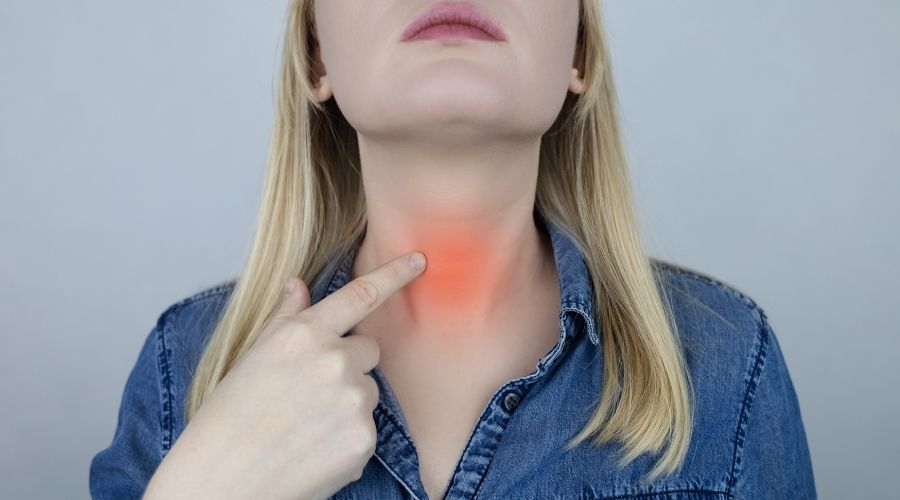
A doctor is feeling around during an unrelated checkup, or a scan gets ordered for something else entirely, and there it is. A lump at the base of the neck nobody knew existed. Sounds alarming the first time you hear it, and most people’s minds go straight to the worst case. It usually isn’t that. Figuring out which category a nodule actually falls into just takes an exam, not a guess, and definitely not a late-night search history full of worst-case scenarios.
What Is a Thyroid Nodule?
It’s a lump or growth inside the thyroid gland, which sits low in the front of the neck, roughly where a bowtie would sit if anyone still wore those. Most nodules cause absolutely nothing. No pain, no pressure, nothing. That’s exactly why so many go unnoticed for years until an ultrasound or CT scan ordered for a completely different reason happens to catch one sitting there.
Most that get biopsied turn out benign. Doctors have gotten reasonably good at telling early which ones need a closer look and which can just be watched. The American Thyroid Association puts the number at somewhere between one in five and one in three adults carrying a nodule at some point in life, whether they know it or not. Age matters too. Older adults turn up with them more often, largely because more imaging happens as people get older for unrelated reasons.
What Actually Causes Them
Honestly, there isn’t a tidy answer here, and that used to surprise me when I first looked into it. Iodine deficiency plays a role in certain parts of the world. Autoimmune conditions like Hashimoto’s can trigger nodules forming over time. Genetics matter too, since they run in families more than people realize. A lot of the time doctors just never find a specific cause, and the nodule sits there without an explanation attached to it, which patients tend to find more frustrating than the nodule itself.
Women get diagnosed noticeably more than men do. Nobody has a fully satisfying answer for that gap, and it remains one of the more persistent open questions in thyroid research.
A fluid-filled cyst is a different animal from a solid mass, worth knowing that distinction exists. Cysts can shrink on their own sometimes, no treatment required. Solid ones are the ones that usually need watching or further testing.
Recognizing the Symptoms
Most nodules cause nothing you’d notice. When something does show up, it’s typically just a lump you can feel, sometimes only apparent when swallowing, sometimes not even that obvious.
Less often, a nodule grows big enough to actually press on things nearby:
- Trouble swallowing, or a sense that something’s stuck in the throat
- A hoarse voice that sticks around longer than any cold would explain
- Racing heart, unexplained weight loss, jitteriness, if the nodule’s pumping out extra hormone
None of that is common. If it shows up though, get it looked at rather than waiting it out for a few more weeks hoping it settles down.
Why Two Different Specialists Get Involved
Thyroid produces hormones, so technically it belongs to endocrinology. But it also sits directly in the neck, which is ENT territory during any routine head and neck exam. Depending entirely on how a nodule turns up in the first place, either doctor might be the first one you see.
Lump or voice change usually means ENT first. Bloodwork flagging something usually means endocrinology takes the lead instead. More often than not the two end up talking to each other anyway once there’s an actual picture to look at.
What an Evaluation Looks Like
Starts simple. Doctor feels the lump, checks the size, whether it moves normally under the skin. Ultrasound comes next almost every single time, since it shows things a physical exam just can’t, solid versus fluid, the shape of the edges, all of it. Bloodwork rounds things out, checking whether hormone levels are actually being affected.
When a Biopsy Comes Into the Picture
Plenty of nodules never need one at all. Just get watched with repeat scans every so often. A fine needle biopsy comes in when the ultrasound raises a specific question about how something looks, and it’s a lot less unpleasant than it sounds, a thin needle and a few uncomfortable seconds, that’s really it.
Getting an Actual Answer
Dr. Raj Bhayani has been doing this for more than 25 years now, board-certified ENT physician and surgeon, seeing exactly this kind of case regularly. He practices out of the New York Institute of Otolaryngology & Aesthetic Surgery, with locations in Bensonhurst, Brooklyn, and Rego Park in Queens. Patients tend to say the same thing after visiting: that he actually explains what’s happening instead of sending them home with more questions than they walked in with.
Found a lump in your neck, or been told you’ve got a thyroid nodule worth a closer look? Call the New York Institute of Otolaryngology & Aesthetic Surgery at (347) 342-1331, or book online to get on Dr. Bhayani’s schedule.
Click here for Related blog
Frequently Asked Questions (FAQs)
Q1: Are thyroid nodules usually cancerous?
No, most thyroid nodules are benign rather than cancerous. However, a thyroid nodule should still be properly evaluated by a qualified healthcare professional. Depending on its size, appearance, symptoms, and other factors, your doctor may recommend imaging, monitoring, blood tests, or a biopsy.
Q2: What is the most common symptom of a thyroid nodule?
Most thyroid nodules do not cause noticeable symptoms and are often discovered during a routine examination or imaging test performed for another reason. When symptoms occur, they may include a noticeable lump or swelling in the neck, difficulty swallowing, pressure in the neck, or changes in the voice.
Q3: Should I see an ENT or an endocrinologist for a thyroid nodule?
The right specialist can depend on how the thyroid nodule was discovered and whether you have symptoms. An ENT specialist may be appropriate for a neck lump, swallowing difficulty, or voice changes, while an endocrinologist may evaluate thyroid function and hormone-related concerns. In some cases, both specialists may be involved in your care.
Q4: Can a thyroid nodule disappear on its own?
Some fluid-filled thyroid cysts may shrink or disappear over time, while solid nodules generally do not disappear on their own. Your healthcare provider may recommend periodic ultrasound monitoring or other evaluation depending on the nodule’s characteristics. Dr. Raj Bhayani and his team in Brooklyn and Queens can help evaluate thyroid and neck-related concerns.