During an appointment, someone says “vestibulocochlear nerve” and half the room instantly checks out. Honestly, medical terms do that to people, even the simple ones like which cranial nerve is responsible for hearing and balance. But knowing the answer to this question actually explains a lot, and it’s one of the more common questions patients ask Dr. Raj Bhayani, mostly right after being told their hearing and balance symptoms are connected.
If you are looking for more information about Dr. Bhayani and his ENT services, you can also visit Dr. Raj Bhayani ENT.
What Cranial Nerve Is Responsible for Hearing and Balance?
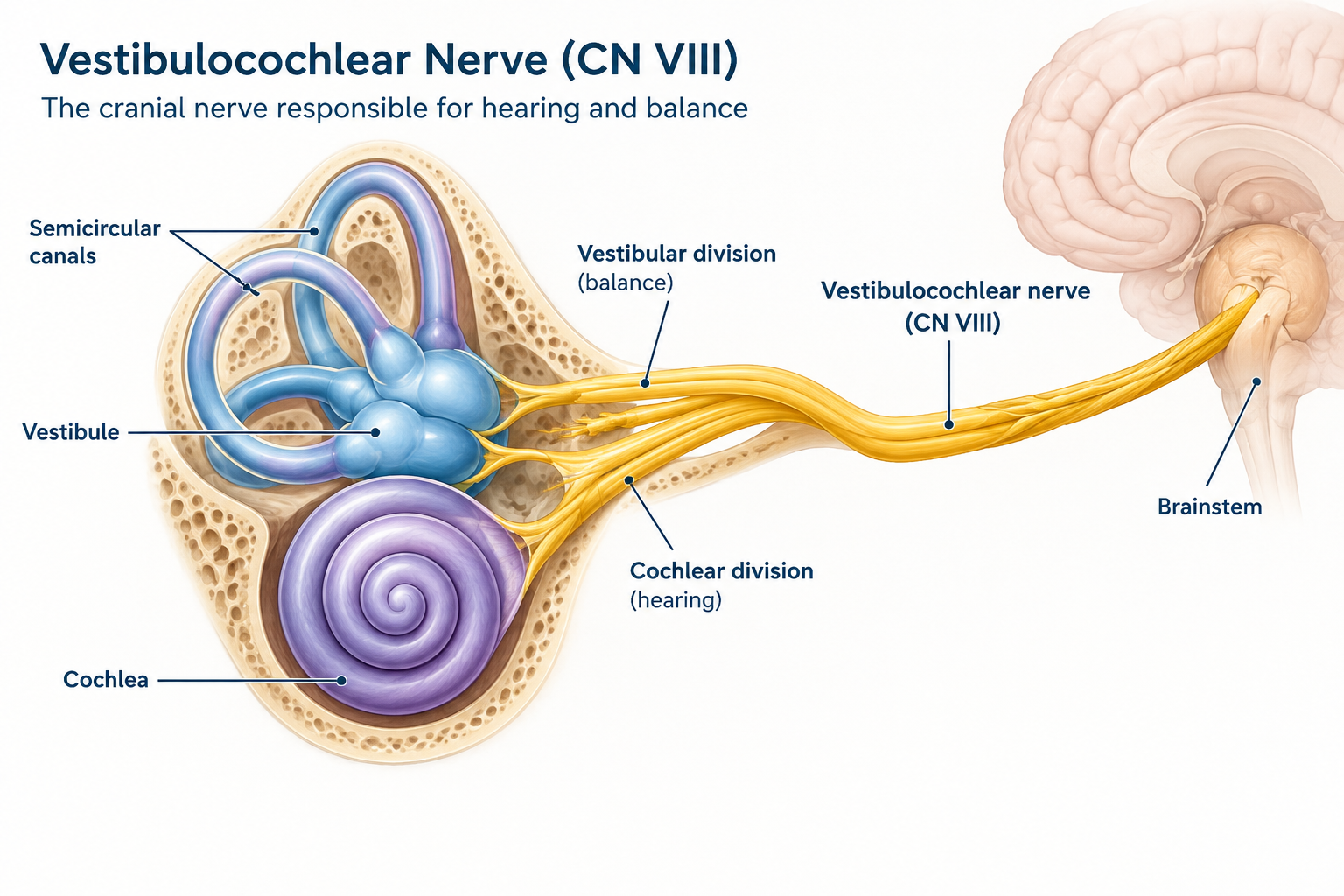
The vestibulocochlear nerve is the eighth cranial nerve (cranial nerve VIII). It carries important sensory information related to hearing and balance from the inner ear to the brain.
The cochlear portion of the nerve carries information related to sound, while the vestibular portion carries information related to balance and spatial orientation. Both systems originate in structures within the inner ear and travel through the vestibulocochlear nerve toward the brainstem.
This is why the question of which cranial nerve is responsible for hearing and balance has one specific answer: the vestibulocochlear nerve, or cranial nerve VIII.
How the Cranial Nerve for Hearing and Balance Really Works
The cochlea converts sound vibrations into electrical nerve signals. These signals travel through the cochlear portion of cranial nerve VIII to the brain, where they are interpreted as sound.
The vestibular system, including the semicircular canals and otolith organs, detects head movement, acceleration, and changes in position. Information from these structures travels through the vestibular portion of the vestibulocochlear nerve to help the brain maintain balance and spatial awareness.
Problems affecting the inner ear or vestibulocochlear nerve can therefore cause hearing symptoms, balance problems, or both, depending on the underlying condition and the structures involved.
For patients looking specifically for an ENT specialist in New York, more information about Dr. Raj Bhayani and his ENT-related services is available at Dr. Raj Bhayani ENT Specialist NY.
Conditions That Affect This Cranial Nerve for Hearing and Equilibrium
Several conditions can cause symptoms involving hearing, balance, or both. Some affect the inner ear directly, while others involve the vestibulocochlear nerve itself.
Meniere’s Disease
Meniere’s disease is associated with abnormal fluid regulation in the inner ear. It can cause episodes of vertigo, tinnitus, a feeling of fullness in the ear, and fluctuating hearing loss.
Vestibular Neuritis
Vestibular neuritis is inflammation affecting the vestibular portion of the vestibulocochlear nerve. It can cause sudden and severe vertigo and imbalance. Hearing is usually not significantly affected.
Acoustic Neuroma
An acoustic neuroma, also known as a vestibular schwannoma, is a usually benign tumor involving the vestibulocochlear nerve. It may cause gradual hearing loss, tinnitus, and balance difficulties as it grows.
Labyrinthitis
Labyrinthitis is inflammation of the inner ear that can affect both hearing and balance. Because the inner ear contributes to both functions, patients may experience hearing changes along with dizziness or vertigo.
- Meniere’s disease can cause vertigo, tinnitus, and fluctuating hearing loss.
- Vestibular neuritis can cause sudden vertigo and imbalance.
- Acoustic neuroma can cause gradual hearing loss, tinnitus, and balance problems.
- Labyrinthitis can affect both hearing and balance because of inflammation in the inner ear.
Symptoms to Watch For
Certain combinations of symptoms may suggest an issue involving the inner ear or vestibulocochlear nerve. However, symptoms alone cannot determine the exact cause and should be evaluated by a qualified medical professional.
- Hearing loss along with dizziness
- Tinnitus with vertigo or a spinning sensation
- Balance problems that become worse with head movement
- Sudden onset of hearing or balance symptoms
- Persistent dizziness or recurrent episodes of vertigo
What an ENT Specialist Actually Looks At
The first step in evaluating hearing and balance symptoms is often a comprehensive hearing examination. This helps determine how well different pitches and sound levels are detected.
If vertigo or balance problems are present, additional vestibular testing may be recommended. These tests help assess how the inner ear and brain work together to detect and respond to movement.
In some situations, imaging such as an MRI may be recommended, particularly when an ENT specialist needs to rule out a structural problem such as an acoustic neuroma.
Dr. Raj Bhayani is an ENT doctor who guides patients through the evaluation process and explains what each test is designed to determine. Patients who want to learn more about his background, ENT expertise, and services can visit Dr. Raj Bhayani New York.
Why Hearing and Balance Are Evaluated Together
Hearing and balance are closely connected because both depend on structures of the inner ear and, in part, the vestibulocochlear nerve. For this reason, an ENT specialist may evaluate both systems when a patient reports dizziness, hearing loss, tinnitus, or related symptoms.
Evaluating these symptoms together can help determine whether they have a common cause or whether separate conditions may be involved.
What Treatment Is Like When the Cause Is Known
Treatment depends on the specific diagnosis rather than simply on which cranial nerve is involved. Once Dr. Raj Bhayani determines what is causing the hearing or balance symptoms, treatment can be tailored to the underlying condition.
Depending on the diagnosis, treatment may include medication, dietary changes, vestibular rehabilitation, observation, or treatment directed at an underlying structural problem.
Vestibular neuritis, for example, may improve with time and supportive treatment, while vestibular rehabilitation can help some patients recover balance function. Management of an acoustic neuroma depends on factors such as tumor size, growth, symptoms, and overall health.
Dr. Raj Bhayani Evaluation Brooklyn
Dr. Raj Bhayani is an ENT specialist who evaluates patients with hearing, balance, dizziness, tinnitus, and other ear-related symptoms. Patients in Brooklyn, Rego Park, Queens, and surrounding New York communities can seek an evaluation when hearing loss, dizziness, tinnitus, or balance problems occur together.
For additional information about Dr. Raj Bhayani’s ENT services and professional information, you can explore Dr. Raj Bhayani ENT, Dr. Raj Bhayani ENT Specialist NY, and Dr. Raj Bhayani New York.
Hearing changes and balance issues occurring simultaneously are worth discussing with an ENT specialist rather than assuming they are unrelated.
Managing hearing and balance problems together? Call the New York Institute of Otolaryngology & Esthetic Surgery at (347) 342-1331 to book an evaluation with Dr. Raj Bhayani, or schedule online today.
Frequently Asked Questions on Which Cranial Nerve Controls Hearing and Balance
Why does hearing loss and dizziness sometimes occur together?
Hearing and balance are both closely connected to the inner ear and the vestibulocochlear nerve, also known as cranial nerve VIII. Conditions affecting the inner ear or this nerve can sometimes cause hearing symptoms and dizziness at the same time.
Are you really worried about acoustic neuroma?
An acoustic neuroma, also called a vestibular schwannoma, is usually a benign tumor rather than cancer. It can cause gradual hearing loss, tinnitus, and balance problems as it grows and may require monitoring or treatment.
Is it possible to have vertigo without any hearing loss?
Yes. Vestibular neuritis primarily affects the vestibular portion of cranial nerve VIII and can cause sudden, severe vertigo without significant hearing loss.
Which cranial nerve is responsible for hearing and balance?
The vestibulocochlear nerve, or cranial nerve VIII, is responsible for transmitting hearing and balance information from the inner ear to the brain.
What is being tested when doctors evaluate hearing and balance?
Evaluation may include a hearing test, vestibular or balance testing, and sometimes imaging such as an MRI when symptoms suggest a structural problem such as a vestibular schwannoma.