Punch to the face. Fall off a bike. A line drive that catches you square between the eyes during a pickup softball game. The nose takes more hits than any other part of the face, mostly because it’s the part sticking out the farthest. Most people who break their broken nose never see a specialist for it. They ice it, maybe tape it up, and a couple weeks later it’s mostly forgotten. Fine, usually. But not always. I’ve talked to plenty of people who found out years later, when they finally got fed up with breathing through one nostril, that a fracture from high school never actually healed right.
So here’s the real question. When do you actually need to call an ENT, and when can you just tough it out?
Why the Broken Nose So Easily
The bony bridge of your nose is thin. There’s not much muscle backing it up. Below the bridge, the lower two thirds of your nose is cartilage, and cartilage tends to bend instead of snap when it takes a low speed hit. Sounds like a good thing. It isn’t always. Cartilage injuries are notoriously hard to see on an X ray, which means people get told “you’re fine, nothing’s broken” when what actually happened is their septum shifted and it’s never going to sit straight again without help.
A true fracture usually announces itself. Sharp pain right away, swelling fast, sometimes a visible bend or flat spot that wasn’t there an hour ago. Two black eyes showing up the next morning looks alarming but by itself isn’t a red flag. What actually matters is happening on the inside of the nose, where you can’t see it in a mirror.
The Window Everyone Misses
Swelling peaks in the first day or two after the injury, and it hides the real shape of the break. That’s why a lot of doctors will tell you to wait three to five days before getting examined properly. Fair enough. Give the swelling time to go down so someone can actually see what’s going on underneath it.
Here’s the part nobody mentions though. Nasal bones start setting into place within about a week to ten days. By three weeks they’re basically locked in. If a fracture needs to be repositioned without surgery (this is called a closed reduction, and it’s a quick in office procedure), it has to happen inside that window. Miss it, and your only option later is an actual surgical rhinoplasty or septoplasty, with real recovery time attached.
So don’t sit on it for three weeks telling yourself it’ll settle down on its own. If your nose looks or feels different than it did before, get it checked within that first week.

When You Shouldn’t Wait for a Regular Appointment
Most nasal fractures aren’t emergencies. A few signs mean you need to be seen right away, not next week.
Clear fluid running from one nostril after a head injury is one of them. That’s not necessarily mucus. It can be cerebrospinal fluid, and it can mean a fracture at the base of the skull, which is a very different problem than a broken nose. One way to check, if it’s dripped onto a tissue or pillowcase: it sometimes leaves a faint ring around a darker center spot, almost like a halo.
A septal hematoma is another. This is a pocket of blood collecting inside the wall between your nostrils, and it looks like a swollen, almost grape like bulge just inside the nose. Both sides feel blocked. If this doesn’t get drained within a day or two, the trapped blood cuts off circulation to the cartilage underneath, the cartilage dies, and the middle of the nose can literally collapse. Doctors call it a saddle nose deformity. It’s permanent. This is genuinely not something to sleep on.
Beyond that: bleeding that won’t stop after ten or fifteen minutes of firm pressure, or bleeding that keeps coming back. Double vision or trouble moving your eyes, which usually points to a fracture involving the eye socket rather than just the nose. Numbness across your cheek or upper lip. And obviously, any sign of a concussion, loss of consciousness, confusion, repeated vomiting, a headache that keeps getting worse. That’s an ER visit no matter what your nose looks like.
When It’s Worth a Visit, Just Not an Urgent One
Can’t breathe well through one or both sides, and it’s been more than five to seven days so the swelling shouldn’t be the whole explanation anymore? Worth a look.
Bridge looks crooked or flattened compared to an old photo of yourself? Worth a look.
New whistling sound when you breathe through your nose? Odd, but yes, worth a look.
A weird sense of fullness or pressure on one side that won’t go away? Could be a deviated septum, could be leftover clotted blood. Either way, get it checked. And if it’s been a week or two and you’re only just now noticing something’s off, that’s still fine. Go ahead and call. You haven’t necessarily missed your shot.
What an ENT Checks That You Can’t See Yourself
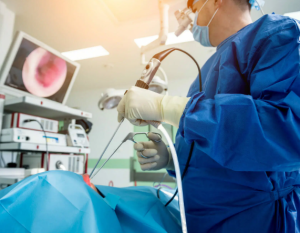
This isn’t just someone looking at the outside of your nose and nodding. A proper exam usually involves a light or small scope inside each nostril, specifically checking for a septal hematoma or a septal fracture blocking airflow, both of which are invisible from the outside no matter how long you stare in the mirror. They’ll also feel around the nasal bones and the bones around your eyes and cheeks, checking for steps or gaps that suggest something broke beyond just the nose itself. Sometimes they’ll have you breathe through one nostril at a time to compare airflow.
As for X rays, honestly, they’re not that useful for nasal bones specifically. Most ENTs go by the physical exam alone. A CT scan only really comes into play if there’s reason to think the injury goes beyond the nose into the surrounding facial bones.
What Happens If You Just Wait It Out
The two most common long term problems from an untreated fracture are cosmetic, an asymmetric or crooked and broken nose, and functional, chronic difficulty breathing through one side. Neither one is dangerous. Neither one is life threatening. But both are dramatically easier to fix in the first two weeks than a year down the line, once everything has healed into its new, wrong position. At that point you’re not looking at a quick in office fix anymore. You’re looking at actual surgery.
Not every bump to the nose needs a specialist. Most heal just fine without anyone ever looking at them twice. The point isn’t to panic every time you get elbowed in the face during a pickup game. It’s knowing the handful of signs that mean this one is different, and not letting “it’s probably fine” carry you past the point where something could’ve been fixed easily.
A phone call to an ENT’s office costs you five minutes. Finding out three weeks too late that you needed that call costs a lot more than that.
Think You Might Have a Nasal Fracture? Don’t Wait Out the Window.
If your nose looks different than it did last week, if you’re still struggling to breathe through one side, or if something just feels off since your injury, Dr. Raj Bhayani at the NY Institute of Otolaryngology can get you evaluated quickly, while a closed reduction is still an option.
With offices in Brooklyn and Rego Park, same week appointments are often available for recent facial injuries.
Don’t let a treatable fracture heal the wrong way just because you waited too long to ask.